


LIFTING DOCTOR NOTE
LIMO PLASTIC SURGERY
manager
60times Date 26-07-29 18:29
- Operator :
- Previous surgery history :
- Significant :
- Age : Gender :
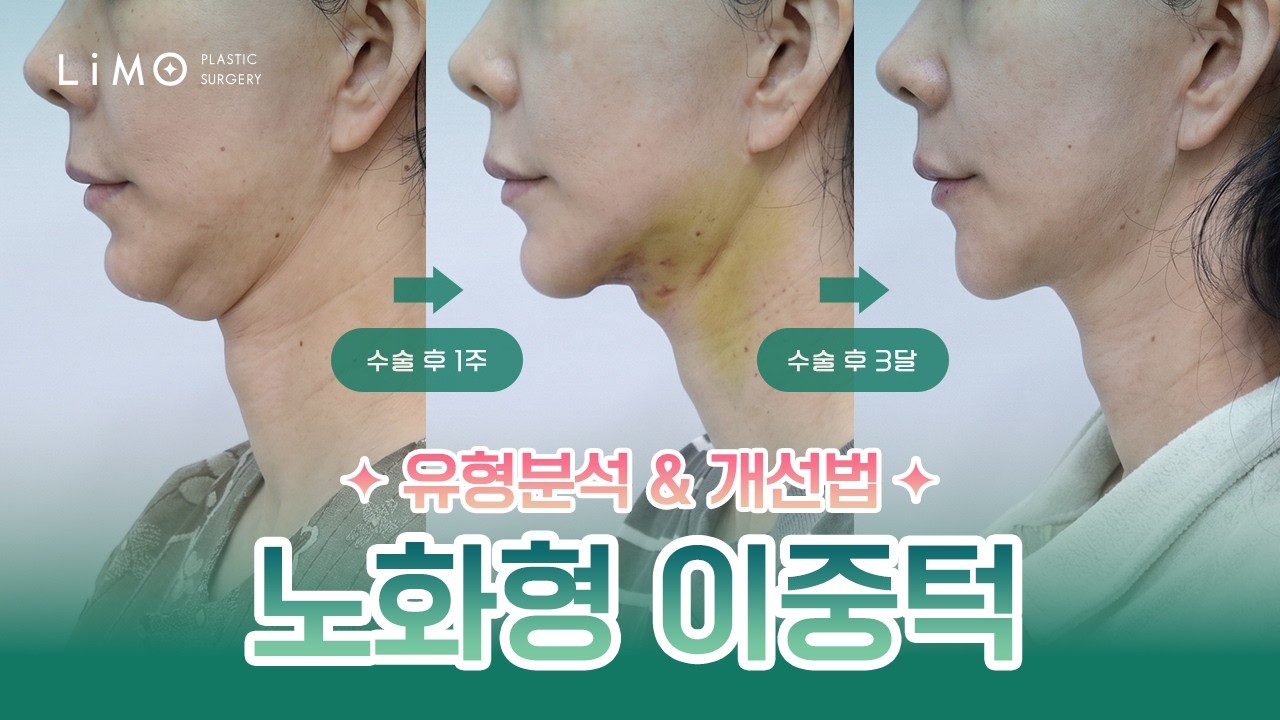
Can age-related double chin with sagging skin be improved through muscle binding without a Deep Plane Face-Neck Lift?
This is LiMO Plastic Surgery Clinic.
In double chin consultations, we frequently receive the question,
"Can improvement be achieved without a facelift?"
Many patients wonder whether a facelift is necessary for age-related double chins accompanied by skin sagging, or whether muscle binding alone can achieve improvement.
we would like to explain the characteristics of an age-related double chin and
its treatment options through actual cases where improvement
was attempted using muscle binding alone.

What Is an age-related double chin?
In many cases, patients who already had a double chin experience
a worsening of the condition as they age, since decreased skin elasticity
causes the skin to sag downward, adding further skin volume
on top of the pre-existing double chin.

Viewed from the side, the area under the chin
appears to protrude convexly, resembling a fat-dominant type double chin.
However, when examined from an oblique angle, vertical lines
may appear where the skin sags beneath the chin.
As skin sagging becomes more severe, the sagging skin itself
becomes more prominent than the convexity.
there is little fat present and the sagging skin is the sole cause,
a facelift is more appropriate than muscle binding.

are those where sufficient fat is present.
This distinction can also be confirmed via ultrasound examination.
Cases suitable for improvement through muscle binding
are thosein which both subcutaneous and submuscular fat are confirmed on ultrasound.
In some cases, the skin may appear thick on ultrasound.
However, this is usually not because the skin itself has thickened, but because the sagging skin folds over beneath the chin, creating that appearance.
Case 1: Age-Related Double Chin with Both Subcutaneous and Submuscular Fat Confirmed on Ultrasound

and the muscle is tightened to prevent it from loosening again.
As the skin adheres closely to this newly formed structure,
significant improvement can be achieved
without extensive direct skin removal, unlike in a facelift.
The submental fat is reduced, and the jawline can become considerably more defined.

Case 2: Age-Related Double Chin That Did Not Improve with Non-Surgical Procedures

In the following case, the area just below the jawbone
temporarily appears indented before becoming convex again.
This is a characteristic appearance caused by sagging skin folding at the jawline boundary.

This patient was aware of both the submental sagging and the presence of excess fat,
and had undergone multiple non-surgical procedures, including
thread lifting, INMODE, and Ultherapy (Shurink).
However, since the effects were minimal and not well maintained,
the patient opted for surgery. Since the sagging of the skin and muscle was difficult
to improve through non-surgical procedures, muscle binding was performed
together with skin fixation, resulting in a well-defined jawline.
Case 3: Double Chin Developed After Facial Contouring Surgery

This excess skin descended beneath the chin, forming a double chin.

so muscle binding was performed instead.


After surgery, the contour beneath the chin was naturally smoothed out,
resulting in a much cleaner jawline.
In some cases, a thin vertical line may remain below the suture site;
this is a skin texture effect caused by the folding of the remaining skin.
Since fully addressing this would require a facelift,
when a significant amount of excess skin remains before surgery,
we also explain the potential need for a facelift.
Case 4: Skin Sagging Worsened After Liposuction

after her double chin worsened following facial contouring surgery.
However, because fat was removed while excess skin was already present,
the skin sagging became even more pronounced.
As this illustrates, repeated liposuction in the presence of existing skin sagging
can actually worsen the sagging.


and the muscle was bound so that the skin
would adhere closely to the newly formed structure.
After surgery, the patient achieved a well-defined jawline and a natural neckline.
Case 5: A Case Involving Both Fat and Skin Sagging

The jawline boundary was not completely obscured,
showing a faint but discernible shadow.
In cases with a large amount of fat, this kind of shadow is often not visible at all;
however, this patient's profile showed indentation on either side of the chin tip,
with sagging only in the central area.

Since both excess fat and skin sagging were contributing factors,
unnecessary fat was removed as much as possible,
and the loosened muscle was tightened to create a structure
that firmly supports the area beneath the chin.
Following this, the skin naturally adhered to the newly formed structure as well.
Case 6: Age-Related Double Chin Occurring in Patients with a Small Chin

the space between the chin and neck narrows,
making a double chin more likely to develop.


however, since the facial sagging was not severe, muscle binding
was recommended instead.
Skin fixation was performed in conjunction with this
to compensate for the structural limitations posed by the small skeletal frame.
At four months post-op, both swelling and bruising had fully resolved,
and the results remained stable.
Case 7: A Case Where a Facelift Was Needed but Muscle Binding Was Chosen Instead

and a facelift was explained as necessary during the initial consultation.
However, the patient had already undergone a facelift previously to address sagging
that developed after facial contouring surgery, and to also address
the convexity beneath the chin, muscle binding
ultimately became necessary as well.

that are difficult to explain in full detail, but this case required
a great deal of consideration and effort.


after surgery, although the chin tip appeared somewhat smaller,
the jawline was maintained in a natural and stable form.

For age-related double chin, accurate diagnosis is most important!
can effectively improve most double chins.
However, not every patient is able to undergo both procedures simultaneously,
and there are also many cases where facial sagging is minimal
while only neck sagging is prominent.
Therefore, what matters most is not the surgical method itself,
but accurately determining which procedure is appropriate for each patient.

through muscle binding alone without a facelift,
the most critical step is accurately identifying patients for whom muscle binding alone
can be expected to produce sufficient results.
Only with in-person examination, ultrasound testing, and extensive surgical experience
can a more accurate diagnosis and treatment plan be established.

depending on the underlying cause.
While some cases require a facelift, in appropriately selected candidates, muscle binding alone can be expected to achieve sufficient improvement.
http://youtu.be/N4cPItqptgk?si=MQJTL348uYp_dyYX
-
26.07.14