


LIFTING DOCTOR NOTE
LIMO PLASTIC SURGERY
manager
18times Date 26-07-16 14:46
- Operator : Dr Lee Ho Jun
- Previous surgery history : Foreign substance injection (long time ago), Facelift Surgery (3 years ago)
- Significant : A foreign substance had been injected a long time ago. The patient had been told that this foreign material would be removed at the time of her facelift surgery 3 years ago; however, feeling that it still remained in place, she decided to undergo revision surgery.
- Age : 49 Gender : Female Thai Patient
Hello. This is LiMO Plastic Surgery.
Compared to Koreans, Thai individuals generally tend to have thinner skin, and it is often more stretchable. Furthermore, since this was a revision surgery, the elasticity of the skin and SMAS overall was likely reduced, and both were likely to be considerably thinned. For this reason, the Dual Plane technique was not given primary consideration.
As it's possible, we tend to favor the Deep Plane approach. However, since a wider range of exploration was needed to remove the foreign material, we proceeded with the Extended Deep Plane technique as our chosen direction.
The location of foreign material that remained unremoved even after the first facelift surgery can generally be narrowed down to two areas:
1) Near the retaining ligaments beneath the fascia: Since volume is typically injected into the area where the lateral cheek has become sunken, foreign material - whether filler, fat, or otherwise - is commonly found in this location.
2) Inside the deep buccal fat pad: The deep buccal fat is located further toward the interior of the face than the retaining ligaments, in a layer deeper than the fascia, and is a structure enclosed within a thin membranous pouch.
This is the area of cheek tissue that becomes noticeably sunken when significant facial fat loss occurs, as in expressions like "skin and bones" or "emaciated"; because this area, like the lateral cheek, is a common site where volume is added when sunken, it is another frequent location.
If the first facelift had been performed properly, the foreign material at location 1) should have already been removed for the most part; and as expected, the remaining foreign material was indeed found inside the deep buccal fat pad.
When removing foreign material, if the surrounding capsule ruptures during removal, clean removal becomes difficult; therefore, it was carefully extracted without rupturing - much like carefully digging out wild ginseng.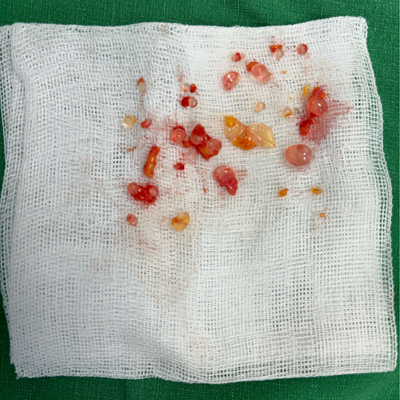
▲ (Photo of the foreign material taken during removal)
Afterward, the procedure continued as always - pulling and fixing the fascia - and proceeded smoothly, being completed without any complications.
Since the foreign material had been creating volume at a considerably deep location so the skin surface remained smooth even after its removal. In fact, with the excessive volume reduced, this turned out to be a case where even greater tightening could be achieved.
-
26.07.16
-
26.07.14