


LIFTING DOCTOR NOTE
LIMO PLASTIC SURGERY
manager
13times Date 26-07-14 11:24
- Operator : Dr. Lee Ho Joon
- Previous surgery history : The patient underwent Face-Neck Lift 8 years ago, and then Thread Lift, Gold Acupuncture etc
- Significant : After the facelift, regularly had thread lifting and other procedures.
- Age : 63 Gender : Female Korean Patient
Hello, this is LiMO Plastic Surgery.
Patients who are considering or have already undergone facelift surgery tend to be more open-minded toward other anti-aging procedures than those who have not. For patients who ultimately decide on a facelift after finding the results of consistent, varied non-surgical treatments unsatisfying, this is likely because they have already traveled that road themselves.
For patients who have already undergone a facelift, it is likely driven by a desire to preserve the results of the lift for as long as possible.
For these reasons, revision facelift often involves encountering not only previously grafted fat or filler, but also lifting threads, gold threads, and in more severe cases - foreign materials such as paraffin.
Since patients themselves frequently do not remember or are unaware of what was previously used, we always keep in mind the possibility of encountering these various types of foreign materials when performing revision surgery.
Among these, lifting threads tend to have the least impact, relatively speaking.
Fat grafting and filler are rarely injected in a way that confines them to a single, specific location - except in particular cases - so they typically affect a broad area of the face.
Gold thread treatments, too, are often scattered widely and sporadically across the facial area, much like fine metal particles dispersed throughout the tissue, meaning the fascia is affected over a broad range.
As for foreign materials such as paraffin, these trigger a chronic inflammatory response that can dissolve the fascia entirely, and the resulting consequences are severe.
Lifting threads, by contrast, are generally thin, and adhesion tends to form only along the specific path the thread travels. As a result, if these localized areas of adhesion are carefully released, damage to the fascia can be kept to a minimum.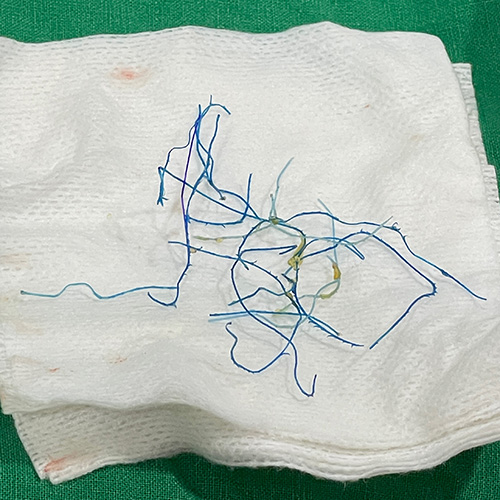
▲ Lifting threads removed during revision Deep Plane Face-Neck Lift
That said, caution is required when a substantial number of undissolved threads remain in place.
In such cases, fascial adhesion tends to be more severe at the points where threads cross one another, and microscopic damage can accumulate during removal, potentially resulting in a perforation of the fascia.
As shown in the image, lifting threads have small barbs, and to remove them while minimizing damage to the fascia, these barbs must be worked with according to their directional orientation. After releasing the thread's fixation points, pulling the thread in the direction opposite to which the barbs are angled allows it to be withdrawn with minimal resistance, thereby minimizing fascial damage.
For this reason, the thread should be removed intact, as a single continuous strand, rather than breaking during extraction. If the thread snaps during removal, it can cause the fascia to tear.
Naturally, achieving this requires considerable experience - the ability to estimate the fixation points and identify the type of thread based on a portion of the lifting thread that is exposed above the fascia or discovered during dissection.
Being treated by an experienced, skilled surgeon is important in any surgical procedure, but in the case of facelift revision surgery - or in cases requiring removal of foreign materials - the gap in outcomes between an experienced surgeon and an inexperienced one can be even more pronounced.
-
26.07.16