


LIFTING DOCTOR NOTE
LIMO PLASTIC SURGERY
manager
73times Date 26-07-14 10:40
- Operator : Dr. Kwon Young Hun
- Previous surgery history : None
- Significant : Sagging breasts after childbirth
- Age : 46 Gender : Korean Female Patient
Hello, this is LiMO Plastic Surgery Clinic.
Through childbirth and breastfeeding, a woman's body undergoes many changes and among these, the change that many women feel the greatest sense of loss over is "Breast Sagging (Breast Ptosis)."
Not only when looking in the mirror, but also the way clothes fit differently - this is a source of significant stress, many patients say.
Many try to improve it through exercise or massage, but eventually feel like they've had enough, seeing the breast can't be improved anymore and seek for surgery.
In toda note, I will clearly explain from a specialist's perspective why breasts sag after childbirth, and the fundamental solution: Mastopexy (Breast Lift Surgery).
1. The Anatomical Reason Breasts Sag After Childbirth
During pregnancy, due to hormonal influences, the mammary gland tissue and fat rapidly expand.
At this time, the skin and Cooper's ligaments that support the breast stretch taut, like a rubber band.
The problem occurs when, after breastfeeding ends, the breast volume decreases. The inner "contents" (glandular tissue) shrink, but the already-stretched "shell" (skin) has lost its elasticity and remains stretched out.
The breast then sags downward, like a deflated balloon. Unfortunately, ligaments and skin tissue that have once ruptured or stretched never naturally recover to their original shape before pregnancy.
This is the anatomical reason why exercise alone cannot restore sagging breasts to their original position.
2. Mastopexy: Removal and Repositioning of Unnecessary Tissue
Mastopexy is not simply a surgery that pulls the breast upward and stitches it in place.
Depending on the degree of sagging, it is a surgery that precisely excises stretched skin and excess breast tissue through an incision around the areola or a vertical incision.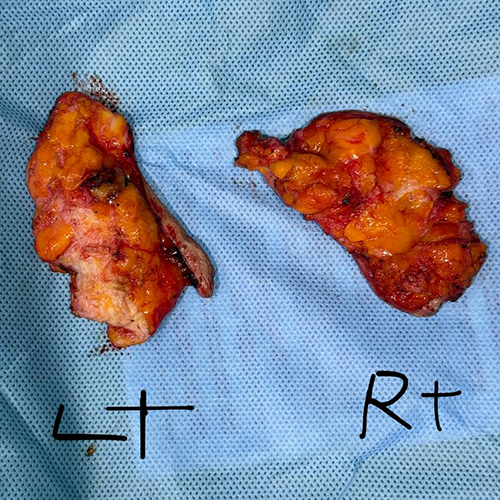
▲ Tissue actually removed during mastopexy performed to improve post-pregnancy sagging breasts
As shown in the photo above, only as much of the sagging tissue as necessary is removed, and the remaining glandular tissue must be firmly fixed and sutured - only then can an elastic breast line be achieved that will not sag again over time.
3. A Choice for an Even More Perfect Shape: Combining with Breast Augmentation
Many patients hope to achieve full volume through breast lift surgery alone, but in fact, mastopexy is a surgery that corrects position - it is not a surgery that increases "volume."
In fact, in the process of lifting the sagging breast, mastopexy can even slightly reduce the size of the breast.
Additionally, in cases with severe upper breast hollowing after childbirth, if only mastopexy is performed, the shape may be lifted but the breast may appear small and flat.
To improve this, combining implant insertion - just like filling a balloon with air - can restore taut skin elasticity and compensate for a hollowed upper breast shape.


▲ Improvement of post-pregnancy sagging breasts through mastopexy combined with implant insertion
By combining implant insertion (Breast Augmentation) in this way, filling the upper breast with volume via the implant supports and holds taut the line refined by the lift, allowing patients to achieve what is often called a "beautiful shape" breast line.
Additionally, as the loose skin is stretched taut by the added volume, patients can achieve a much younger and more vibrant form.
As you can see, sagging breasts go beyond a mere issue of appearance and are directly connected to a woman's confidence.
Since the appropriate surgical method varies depending on the stage of sagging (how far the nipple position has descended relative to the inframammary fold), it is strongly recommended to consult with a specialist who has a deep understanding of anatomy to determine the incision placement and whether to combine with Breast Augmentation or not.