


LIFTING DOCTOR NOTE
LIMO PLASTIC SURGERY
manager
137times Date 26-07-15 10:46
- Operator : Dr Lee Ho Jun
- Previous surgery history : Double-chin liposuction during a facial contouring surgery 10 years ago
- Significant : Reports that sagging worsened after the liposuction
- Age : 50 Gender : Korean Female Patient
Hello, this is LiMO Plastic Surgery Clinic
After double-chin liposuction, the subcutaneous fat under the chin decreases - that's common sense.
However, if the area under the chin still looks bulky even after time has passed, it is very likely not the remaining fat. Still, rather a "sagging platysma muscle" (the muscle under the chin) and "fibrotic tissue" that formed after the surgery are the main causes for the bulging submental area.
1. Why the Area Under the Chin Still Looks Bulky After Liposuction: "Fibrotic Tissue" and the "Platysma Muscle"
Looking at actual revision surgery cases, the shape of the tissue beneath the chin differs from what is typically seen.
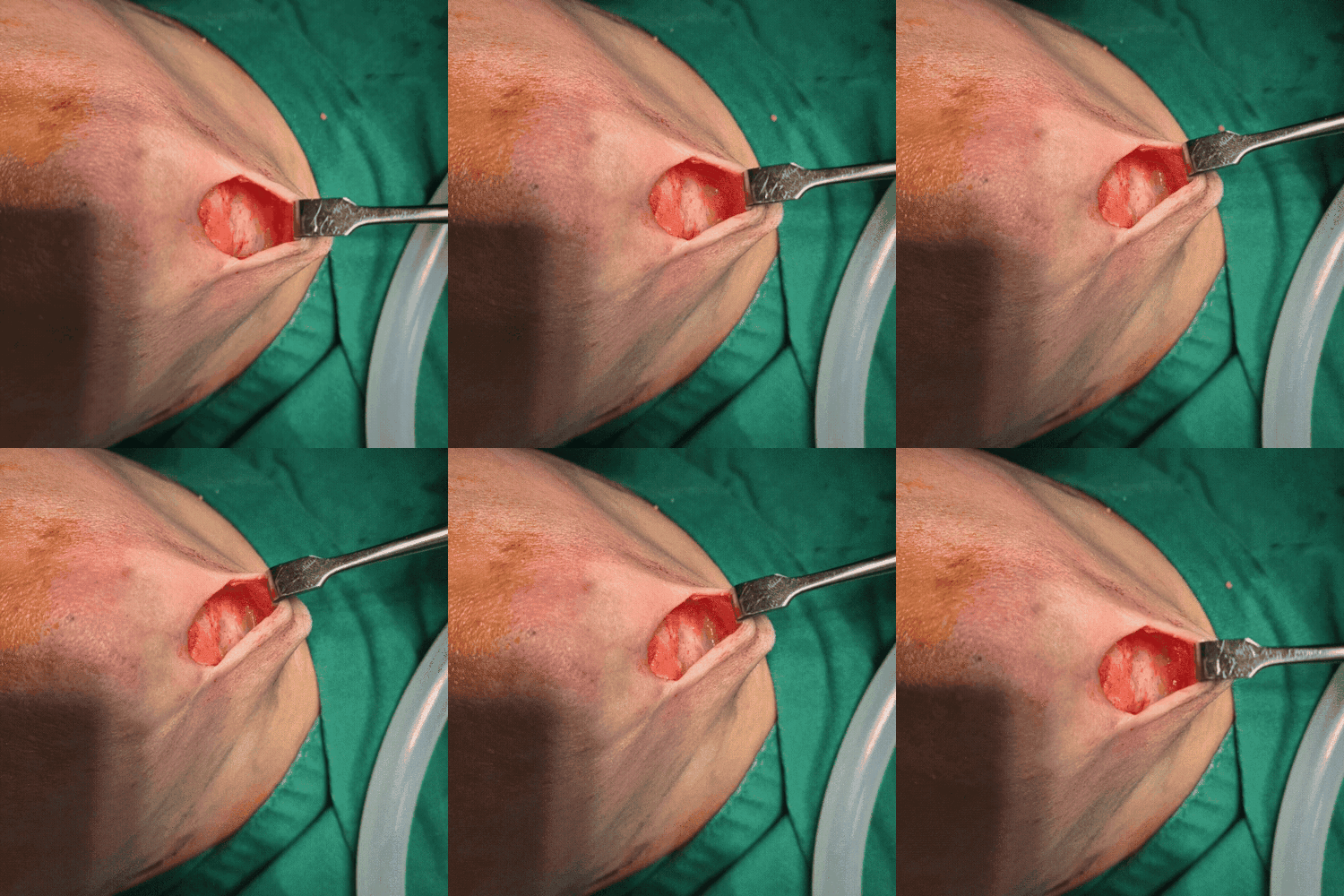
▲ Emptied fat tissue after liposuction, with fibrotic tissue laid over it in a whitish layer
Due to the liposuction, the subcutaneous fat that once covered the platysma muscle in a yellowish layer has disappeared, and in its place, white fibrotic tissue now covers the area like a tough shell.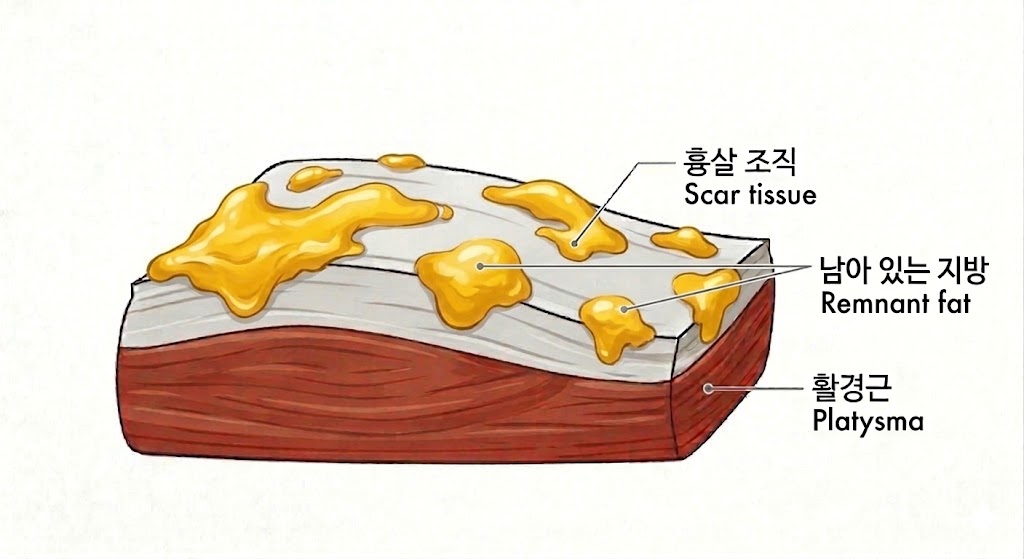
In the photo below, you can see that this tissue creates volume similar to fat, forming bulk under the chin.
Many people mistake this for "gaining weight again," but in reality, it is sagging muscle combined with fibrotic scar tissue.

▲ A fibrous membrane layer (fibrotic tissue layer) formed by intertwining with remaining fat
As you can see, the fibrotic layer can sometimes form thick enough to offset the volume-reduction effect of the liposuction.
Because fibrotic tissue forms from the entanglement of remaining fat and newly formed fibrous tissue, it is often even thicker than the platysma muscle itself.
2. The Key Is "Precise Dissection and Removal of Fibrotic Tissue"
To get straight to the conclusion: platysma muscle binding surgery (platysmaplasty) is entirely possible even after double-chin liposuction, and the results are reliably effective.
However, it requires a far more delicate technique than the first surgery. Here's why:
1) Removing the fibrotic shell: The tough fibrotic membrane adhered to the platysma muscle must be carefully separated and removed. Because the fibrotic tissue and the platysma muscle are strongly adhered to one another, great care must be taken, as the muscle itself could be accidentally removed along with it.
2) Separating the muscle: After clearing away the fibrotic tissue, only the intact platysma muscle must be cleanly isolated. The muscle must remain undamaged throughout this process to retain enough strength to support the area under the chin.

▲ Intact platysma muscle after the fibrotic tissue has been dissected
3) Tightly binding the platysma muscle: The separated platysma muscle is drawn together at the center and tightly sutured. At this stage, not only the separated muscle but also any remaining fat nearby must be meticulously refined to achieve a smooth contour.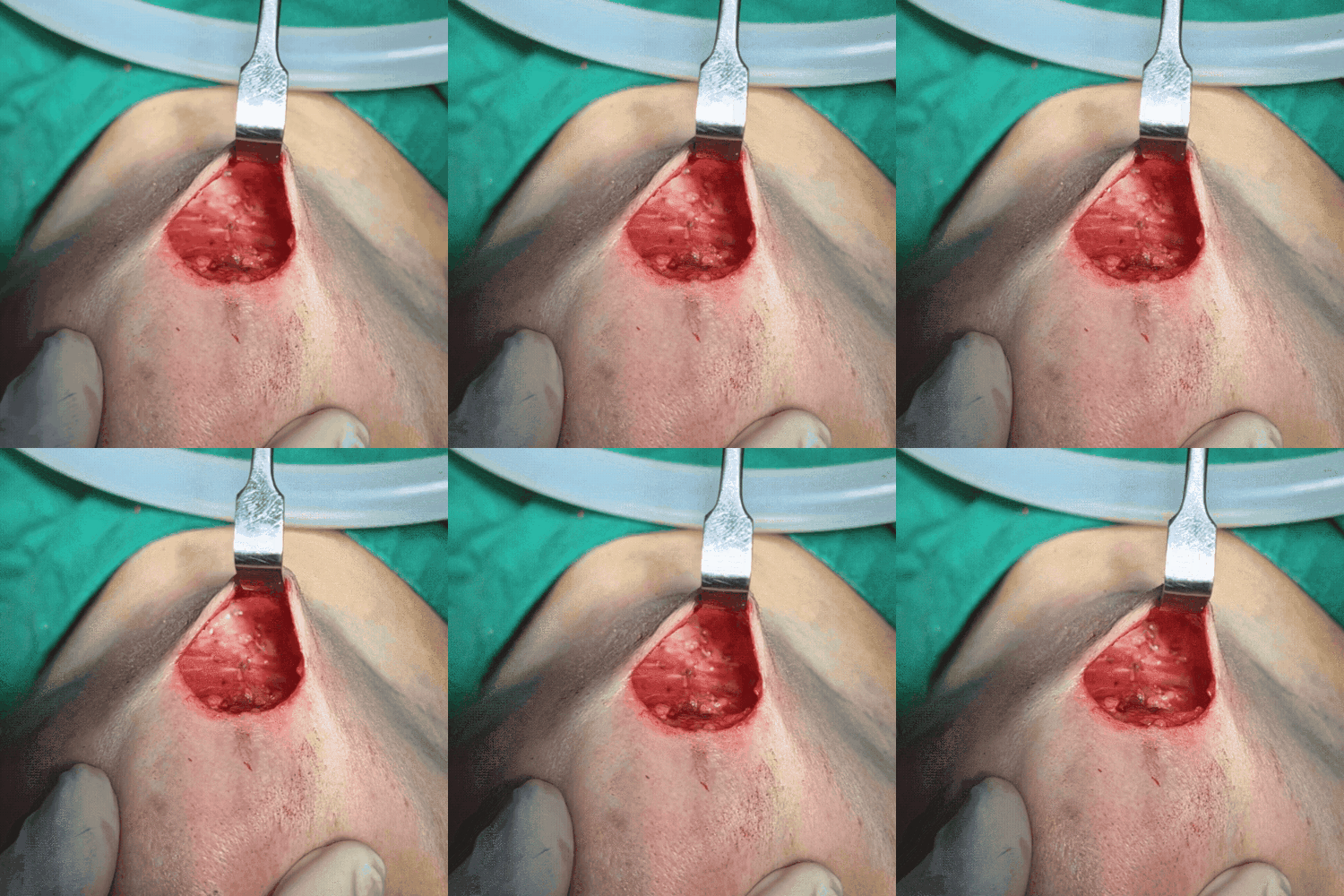
▲ The platysma muscle tightly sutured to support the area under the chin
In this way, even damaged tissue can be surgically corrected with precision, following the natural anatomical structure, to go beyond simply fixing the shortcomings of a previous surgery and achieve a dramatic before-and-after difference.
3. Cases Where the Surgical Outcome May Be Limited (Caution)
Of course, not every case delivers dramatic results. The most important factor is "at what depth the previous liposuction was performed."
If only the subcutaneous fat in the correct layer was targeted, then even with fibrotic tissue present, there should be no major issue with performing muscle repair after its removal.
However, if the liposuction went deep enough to damage the platysma muscle, reaching the deeper fat layer and severely tearing or damaging the muscle itself, then there may not be enough muscle strength left to draw together; thus the surgical outcome may be limited.
In summary, even if you have already had liposuction to get rid of the double chin, the result will not be satisfactory unless the muscle under the chin has been properly addressed. Fibrotic tissue is an obstacle, but with an experienced specialist who can precisely dissect it and reposition the muscle, visible improvement is entirely possible.
Rather than jumping straight into considering revision surgery, we recommend first getting an accurate diagnosis of whether your current condition under the chin is due to "fat," "muscle sagging," or "fibrotic tissue." Precise Platysmaplasty surgery can be the only viable solution for a liposuction that didn't deliver the desired result.