


LIFTING DOCTOR NOTE
LIMO PLASTIC SURGERY
manager
128times Date 26-07-14 16:56
- Operator : Dr. Lee Ho Jun
- Previous surgery history : None
- Significant : A case with a significantly large volume of fat
- Age : 33 Gender : Female Korean Patient
Hello, this is LiMO Plastic Surgery.
When it comes to removing the double chin that causes so much stress every time you take a photo, "liposuction" is undoubtedly the first method that comes to mind.
However, contrary to the expectation that simply removing fat will produce a sharp, defined jawline, many patients are left disappointed by a chin area that still appears bulky even after surgery.
Why is simple liposuction alone limited in its ability to remove a double chin? And why is muscle tightening a more effective approach?
1. Liposuction Cannot Completely Remove "Subcutaneous Fat"
One common misconception is that liposuction can reduce the fat in a given area to nearly zero. However, what is actually observed during surgery tells a different story.
When eating meat, you may notice that the flesh near the tendons doesn't come off easily and can be quite tough. The human body works similarly: while some fat can be smoothly suctioned out through a straw-like cannula, there are also areas where firm, tough tissue exists to maintain the body's structural form. Fat attached near this tough tissue adheres so tightly, almost as if adhered, that cannot be removed without being surgically removed.
The issue is that, while the exact amount may vary by individual constitution, this tough tissue is distributed throughout the entire submental (under-chin) area, and a substantial amount of fat is attached both above and below it.
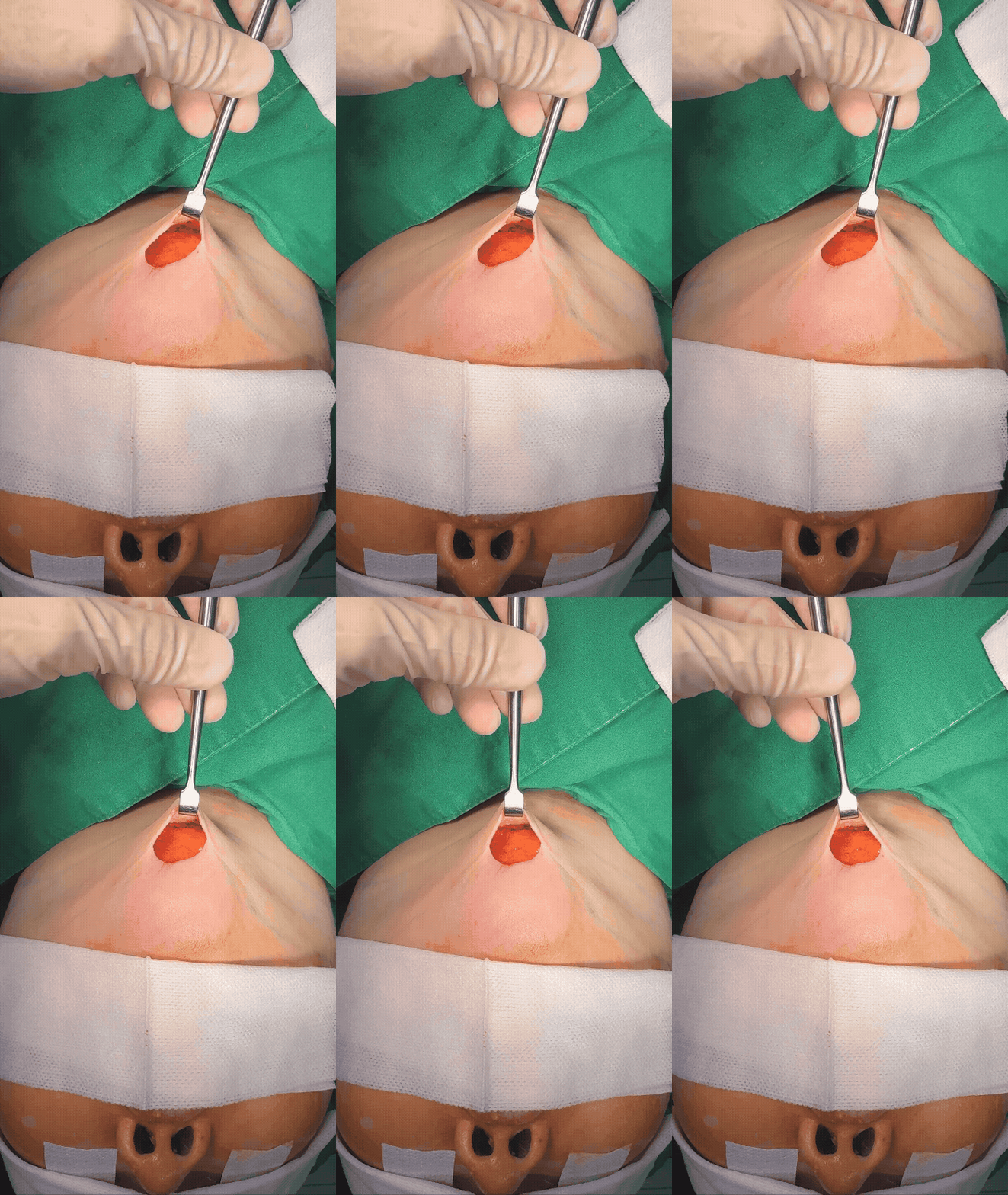
▲ Subcutaneous fat that remains even after liposuction for double chin removal
Before performing muscle binding, we first carry out liposuction to create smooth contours and minimize bleeding. However, when we look inside the area after liposuction during the actual muscle binding step, we still observe layers of subcutaneous fat that could not be removed by suction alone.
In other words, liposuction alone has structural limitations in achieving the "super snatch" slimness that patients desire, making double chin removal 100% challenging.
2. The Key Lies in the "Deep Fat" (Submuscular Fat) Hidden Beneath the Muscle
There is an even greater limitation to liposuction: it cannot address the "deep fat" (Submuscular fat) which accounts for a significant portion of the volume under the chin.
The structure beneath the chin is layered as follows: skin – subcutaneous fat – platysma (muscle) – deep fat (submuscular fat).
While a liposuction cannula (suction tube) can easily remove subcutaneous fat as the particles are small and separate easily like grapes, it struggles to break apart the deep fat, which is enclosed in a tough membrane and exists in large masses.
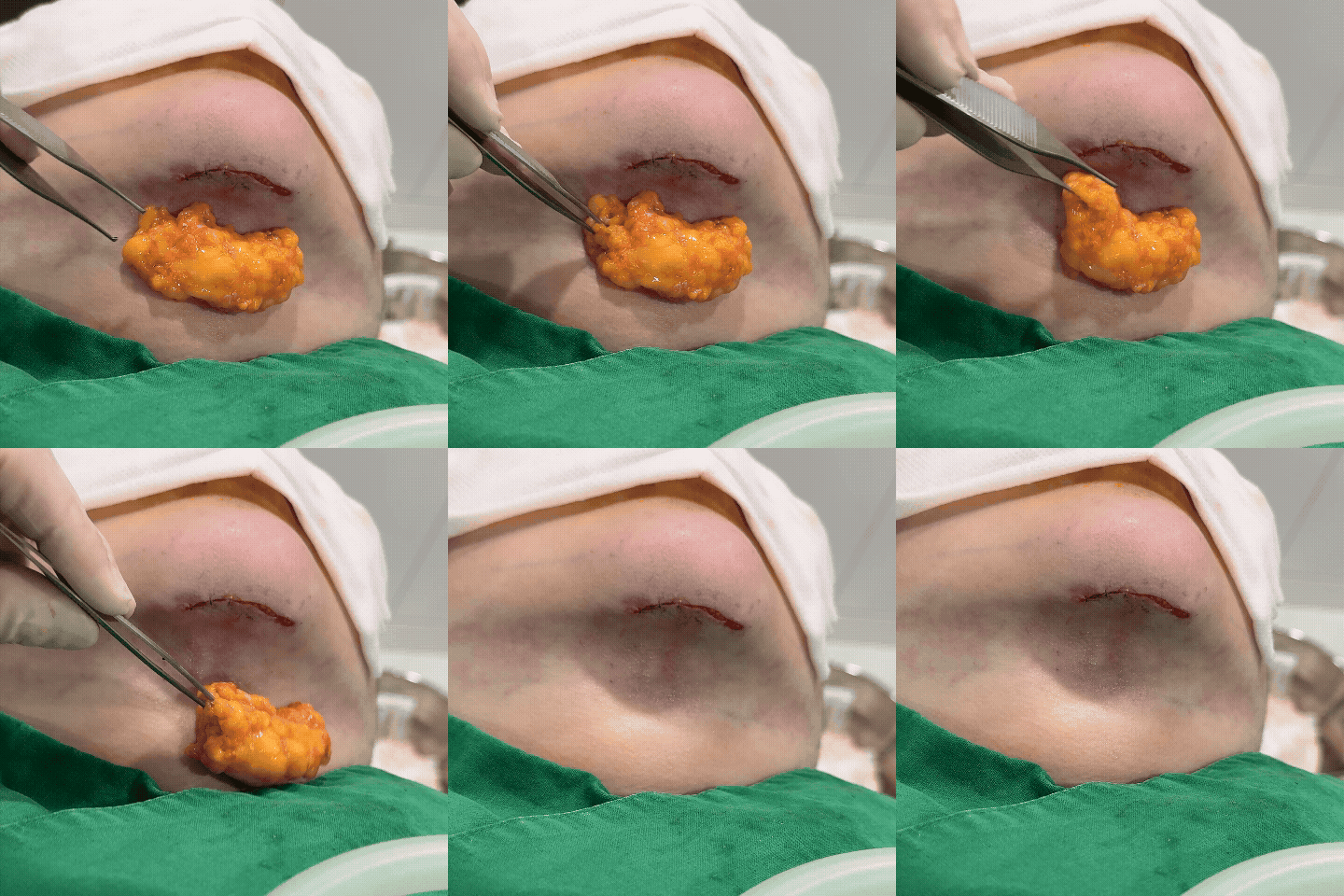
▲ Deep fat removed from beneath the platysma muscle
Even in patients who have lost weight or have a naturally slim body but still struggle with a double chin, the deep fat beneath the platysma muscle is often just as thick as the subcutaneous fat layer. No matter how thoroughly the outer subcutaneous fat is removed, if this "deep fat" remains densely packed beneath the muscle, the effectiveness of Double Chin Removal surgery will inevitably be cut in half.
The only method that allows this deep fat to be safely removed under direct visualization is "Platysmaplasty", or also called Double Chin Removal Surgery.
3. "Tightening" Is Just as Important as "Removing"
If the procedure ends with just fat removal alone, the area under the chin will become loose, like a deflated balloon. The reason muscle tightening is overwhelmingly more effective than liposuction is that it involves structural reinforcement as well.
If the remaining muscle and skin cannot adhere closely to fill the space left behind after the deep fat and subcutaneous fat have been removed, there is a limit to how much the sagging under-chin shape can be improved. Muscle binding closes this space by tightening the muscle, allowing the skin to follow and adhere along the tightened muscle.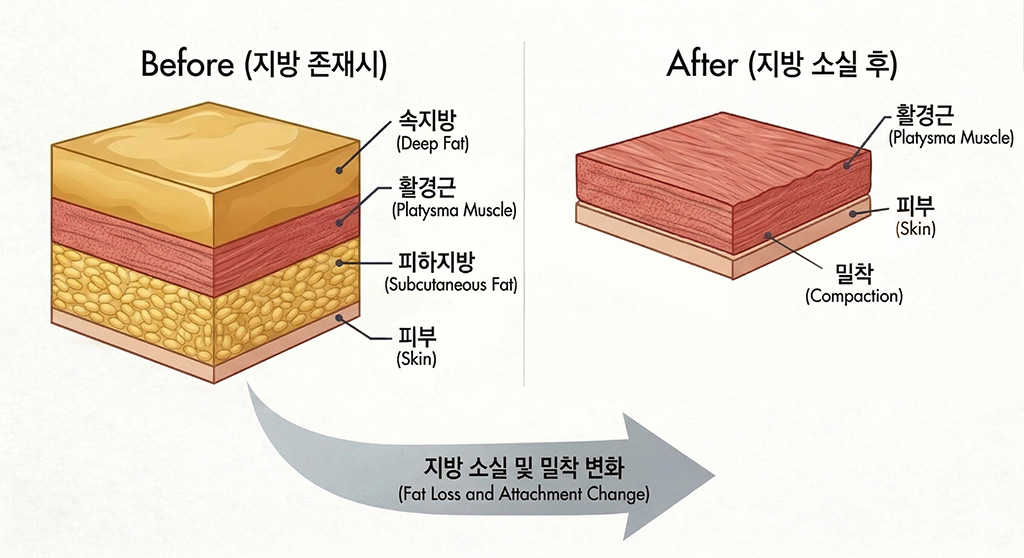
In conclusion, liposuction - which only addresses subcutaneous fat, accounts for only about half of the overall improvement. Platysmaplasty, or also called Double Chin Surgery, on the other hand, not only clears the subcutaneous fat but also simultaneously removes the deep fat (submuscular fat) that suction cannot reach and tightens the muscle, producing reliable and more defined double chin removal results.
If a "Double Chin" that you assumed was simply a matter of "excess fat" isn't improved after diet or exercise, the problem is likely not the amount of fat, but rather its depth and the looseness of the underlying muscle. Ultimately, dramatic results and long-term maintenance depend on how precisely and how deeply the treatment addresses these underlying layers.