


LIFTING DOCTOR NOTE
LIMO PLASTIC SURGERY
manager
123times Date 26-07-15 18:21
- Operator : Dr. Lee Ho Jun
- Previous surgery history : None
- Significant : Retaining ligaments were released, followed by removal of excess fascia
- Age : 53 Gender : Female Korean Patient
Hello, this is LiMO Plastic Surgery Clinic.
Many people consider a facelift as a way to reverse the sagging that comes with age. But what happens if the procedure simply involves pulling the skin tight and suturing it? In most cases, the results relapse quickly, often leaving behind nothing but ear deformities, also called "Pixie Ears Deformity" and uneven scarring.
The success or failure of a facelift doesn't depend on the visible skin surface - it depends on the retaining ligaments deep beneath the skin, which firmly anchor the facial tissue in place.
1. What Are Retaining Ligaments?

As shown by the white vertical lines in the image, our face contains tiny structural columns that firmly connect the bone, the muscle layer (SMAS), and the skin in a vertical direction. These are the "retaining ligaments." When we're young, they serve as a helpful support system that keeps facial tissue from sagging. However, during a facelift, they play a very different role.
2. Why Must the Retaining Ligaments Be Released?
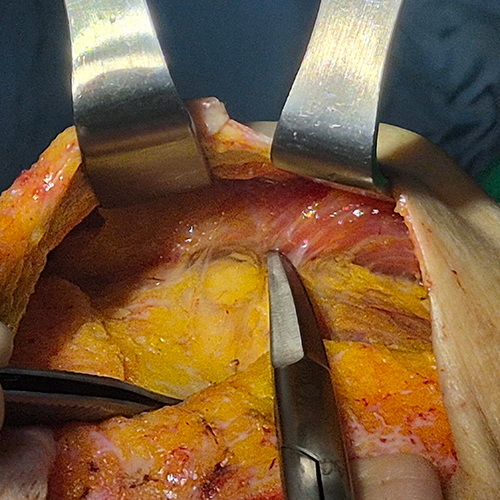
The goal of a facelift is to move the sagging SMAS (fascia) layer back to its original, higher position and remove the excess skin. However, if these retaining ligaments remain firmly attached, the sagging tissue will try to stay in place - almost as if it were tied down by stakes - no matter how firmly it's pulled. This is why, if the retaining ligaments are not properly released and the tissue is forcibly pulled instead, the following problems can occur:
1) Unnatural results: Since the underlying structure remains unchanged while only the surface is pulled, the shape of the mouth can look unnatural, or the face may appear overly flat and wide.
2) A shorter-lasting result: Because of the ligaments' natural pulling force (tension), the face may look taut immediately after surgery, but it will quickly try to return to its original position.
3) Worsened scarring: The forced tension concentrates at the suture site, which can widen the scar or distort the shape of the ear.
3. The Difference Made by Thorough "Retaining Ligament Release" and Extensive "Dissection"

▲ LiMO's Deep Plane Face and Neck Lift dissection range
A successful facelift requires precisely locating and releasing these retaining ligaments through a dissection process. Only by releasing these firm anchor points, the sagging fascia layer can finally move freely upward.
Once sufficient dissection has been performed, the fascia is repositioned upward, and the excess skin is closed loosely, without tension - only then can a natural, long-lasting result be achieved. When the fascia is able to move freely, a significant amount of it can be trimmed away even through repositioning alone, without relying on tension.
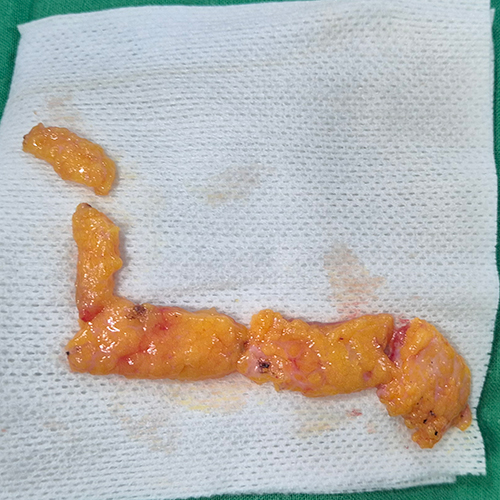
▲ Fascia removed after repositioning
A facelift is not simply a procedure of pulling the skin tight - it is a precise surgery that repositions the face's underlying anatomical structures. As shown here, what matters most is the surgeon's skill in safely and reliably accessing the deeper tissue layers to properly manage the retaining ligaments.
Rather than a facelift that only tightens the surface, we hope that you can experience a true "reversal of aging" through a procedure that properly releases and rebuilds the structures from within.