


LIFTING DOCTOR NOTE
LIMO PLASTIC SURGERY
manager
131times Date 26-07-14 11:29
- Operator :
- Previous surgery history :
- Significant :
- Age : Gender :
#1. Definition and Effects of a Facelift
A facelift refers to a surgical procedure that lifts and fixes sagging facial skin and the underlying muscle layer caused by aging. Rather than simply pulling the surface skin, its defining feature is that it addresses the core tissues that maintain the three-dimensional structure of the face.
Because of the term "facelift," some mistakenly believe that all facial wrinkles are improved by the procedure. Strictly speaking, however, this is not accurate - it is primarily a surgery that improves the mid, lower face and neck. In other words, it lifts tissue that has sagged downward due to aging, thereby improving marionette lines, jawline definition, and neck sagging, and creating a more defined facial contour.
Nasolabial folds do improve to some extent as well, but since their cause is not merely sagging but also hollowing due to atrophy of bone, fat, and muscle so correction is only achievable to a certain degree when "lifting" of sagging tissue is combined with restoring lost volume in sunken areas.
#2. History of Facelift Surgery
1) Early 20th Century: The Beginning of Facelift Surgery
Facelift surgery began in the early 20th century. While there is some debate over exactly who was the first one ever performed it, it is generally considered to have started sometime in the first decade of the 1900s.
Early attempts: One of the earliest documented cases is often cited as Hollander's 1901 procedure on a Polish noblewoman, in which he removed strips of skin along the hairline and natural creases to reduce wrinkles.
Notable early doctors: Lexer reportedly performed surgery on an actress in 1906, and Joseph corrected the aged cheek tissue of a 48 years old woman in 1912.
Nature of the surgery: Early facelifts were limited to simply excising and suturing skin, without any subcutaneous dissection.
2) Establishment of Technique and Social Perception (1920s–1960s)
Standardization of technique: In the 1920s, Bettman described a continuous incision connecting the temple to the areas in front of and behind the ear, and Bames recommended a technique of undermining beneath the skin layer to reposition the skin. This became the standard basic facelift technique for the following roughly 40 years.
A secretive procedure: At the time, facelift surgery was often dismissed by both the medical community and the public as a "vanity procedure," and was frequently performed in secret. Even well-known plastic surgeons had to operate in private clinics or conceal the name of the procedure.
Limitations of early surgery: The skin-only undermining approach of this era had inherent limitations, as it could not address the aging changes occurring in deeper structures such as muscle, fat, and so on, or the effects of gravity on those layers.
3) The Advent of Modern Facelift Surgery: Discovery of the SMAS (1970s Onward)
Beginning in the 1970s, surgeons started addressing tissue layers deeper than the skin, ushering in the era of modern facelift surgery.
Introduction of the SMAS concept: In the early 1970s, Skoog described a technique that lifted the deep fascial layer together with the skin. Subsequently, in 1976, Mitz and Peyronie anatomically defined the SMAS (superficial musculoaponeurotic system) layer, clarifying that tightening this layer was beneficial to surgical outcomes.
Understanding of retaining ligaments: In 1989, Furnas described the facial retaining ligaments, leading to an understanding of how these ligaments loosen with age, causing fat to sag.
Development of diverse techniques: Following this, various methods were developed, including approaches that create SMAS flap (deep plane), subperiosteal dissection techniques, and endoscopic techniques - enabling more refined surgery approaches tailored to each patient's condition.
4) Recent Trends: Combination with Volume Restoration
Recent facelift surgery goes beyond simple lifting and is now often combined with restoring facial volume lost to aging.
Combination with fat grafting: As it became known that facial fat is compartmentalized, the concept of injecting fat into deficient areas to "re-inflate" the face has become an important part of the surgery.
3. Facelift Surgical Techniques
Facelift surgery has evolved in line with its history. Depending on whether only the skin layer is lifted or the SMAS fascial layer is lifted as well, and depending on the method of lifting used, surgical techniques are classified differently and vary in difficulty.
1) Subcutaneous Facelift (Skin-only Undermining)
In its early form, facelift surgery simply involved pulling and suturing the skin. While no surgeon today advertises performing a skin-only lift, such cases are sometimes observed during revision surgeries. That said, skin-layer undermining remains a fundamental technique underlying all the various facelift methods described later with precise dissection at the correct thickness is necessary to create a sufficiently thick SMAS flap that is capable of stably transmitting tension.
If only the skin layer is undermined and pulled, without engaging the deeper tissue, the result - as shown in photos - will be quite problematic with widened scar, pulled and stretched-looking ear while the jawline and neck sagging remain largely unchanged.
A facelift is meant to achieve balanced lifting of the face, but when only the lateral side is pulled, the resulting facial shape and contour can look unnatural. 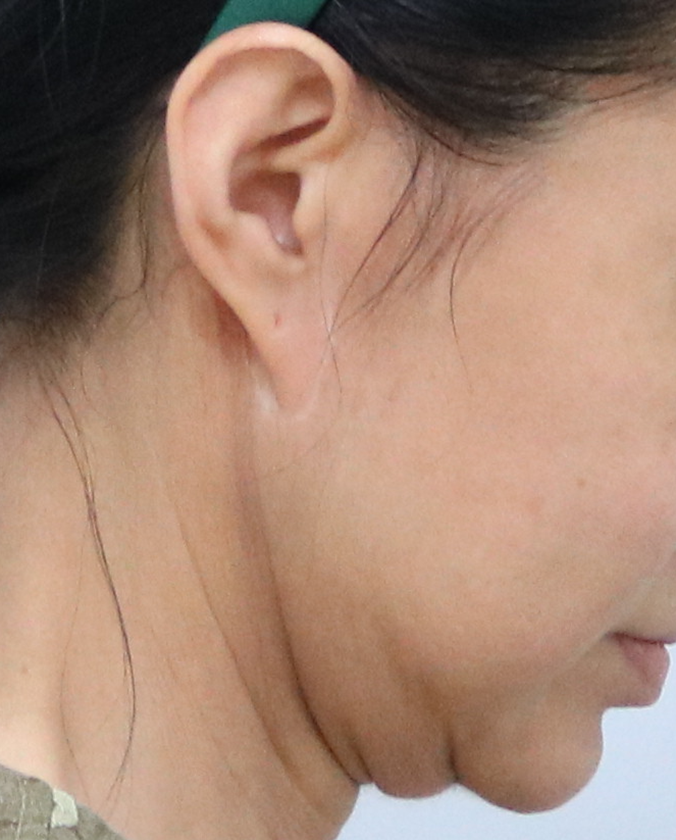
In such cases where only the lateral area has been lifted, excess skin becomes especially noticeable when the patient tilts their head downward.
2) SMAS Plication

This technique involves undermining the skin (as indicated by the red line) and then, rather than separately dissecting the SMAS, pulling it tightly through overlapping sutures (plication). Compared to the techniques described below, it is less invasive, causes less swelling, and takes less time. But because the retaining ligaments cannot be released, its effect is limited. In cases where the retaining ligaments are particularly firm or adhered, SMAS elasticity may be reduced so the achievable effect is reduced.
A similar technique that also minimizes incisions is the MACS facelift. In this method, an incision is made from the temple to the area above and in front of the ear, and a thread is used to create a loop for fixation. This can be understood as the foundational technique behind the "MINI Lifting" procedures widely performed today. Of course, current MINI Facelift techniques vary significantly between surgeons in incision method, extent of dissection, and fixation technique etc making it difficult to describe them under a single standardized approach.
3) SMASectomy
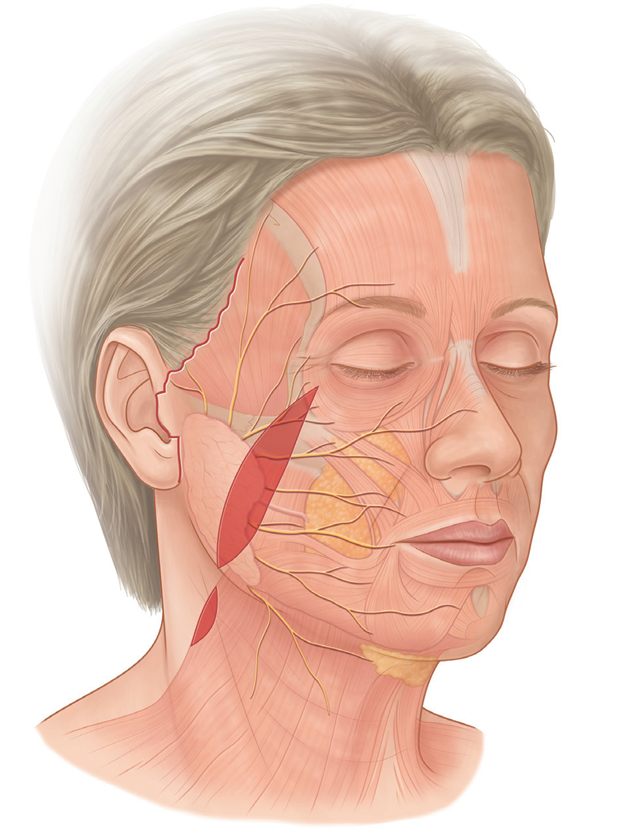
SMASectomy
In this procedure, the skin is undermined to expose the SMAS layer, after which the sagging SMAS is excised along the direction of the wrinkle lines and then sutured. Because deep-layer dissection is not performed, the risk of nerve injury is lower and operating time is shorter. However, a certain degree of surgical skill is required, since particular care must be taken not to go too deep when removing the SMAS layer in order to avoid nerve damage. Additionally, because the retaining ligaments are not sufficiently released before suturing, marionette lines, jawline definition, and neck sagging may not be fully corrected.
4) Composite Facelift (Deep Plane)
This is the Deep Plane technique, one of the most widely used facelift methods in the world today. Rather than separating the skin and SMAS layers, this method lifts them together as a single unit.
Because the skin and fascial layer are lifted simultaneously, this technique can apply greater lifting force and better restore lost volume - advantageous even in patients whose fascia has become thin or weakened from prior thread lifts, laser treatments, liposuction, or contouring procedures. Representative surgeons using this technique include Dr. Mendelson in Australia and Dr. Jacono in the United States, both of whom are now leading surgeons in Deep Plane Facelift surgery. Their approach minimizes skin dissection and, from a certain point, lifts the skin and SMAS together as a unified layer.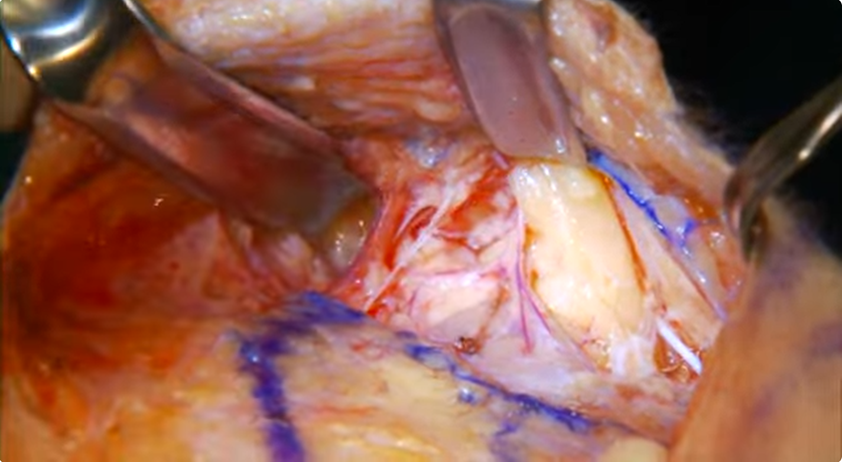
Credit: The Technique for Complete Composite Facelift - Dr Bryan Mendelson

Deep Plane Facelift
5) Extended SMAS Facelift
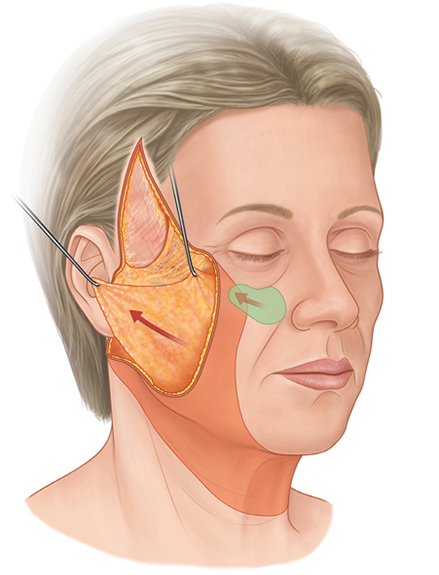

Dual Plane Facelift
Along with the Deep Plane technique, the Dual Plane technique is one of the most commonly used methods today. It is called "Dual Plane" because the skin layer is undermined first, and the SMAS flap is then separately dissected, creating two distinct layers.
Similar to the Deep Plane approach, this technique allows for full release of the retaining ligaments and deep-layer dissection, with the added advantage of being able to handle the skin and SMAS layers separately. However, because the skin and fascial layer are not lifted together as in the Deep Plane method, the force transmitted to the deeper layers may be somewhat reduced, and because the layers are separated, surface irregularities may persist longer. Since every technique has its own advantages and disadvantages, rather than insisting on one method as universally correct, selecting the approach best suited to the individual patient is likely to be more beneficial.
4. Conclusion on Incisional Lifting Techniques
Because the degree of facial aging and the desired outcome differ from person to person, we do not believe any single surgical technique can be considered universally "correct." Whichever method is chosen, if it can deliver patient satisfaction within a safe range, that is, in our opinion, the best possible outcome for cosmetic surgery. It is also true that some published studies have found that the technique a surgeon is most experienced with tends to yield the best results. At present, in Korean Plastic Surgery practice, SMASectomy, Deep Plane, and Extended SMAS are the predominant mainstream techniques. While which technique a surgeon primarily performs is important, we believe what matters most is whether that technique, when actually applied to real patients, produces good results and that is our conclusion.