


LIFTING DOCTOR NOTE
LIMO PLASTIC SURGERY
manager
18times Date 26-07-14 11:27
- Operator : Dr. Kwon Young Hun
- Previous surgery history : The patient underwent MINI Facelift 5 years ago
- Significant : After the surgery, Pixie Ear Deformity appeared
- Age : 49 Gender : Female Chinese Patient
Hello, this is LiMO Plastic Surgery.
Recently, we have seen a growing number of patients, not only middle-aged and older individuals but younger patients as well, seeking facelift surgery to improve sagging facial contours.
Before undergoing surgery, it is totally natural for anyone to have concerns about potential side effects. And among the most commonly cited concerns regarding facelift complications are bad scarring and ear deformity.
So today, we would like to focus specifically on one such deformity known as the "Pixie Ear" (or "Elf ear"), a condition in which the earlobe is pulled downward into an elongated shape, and discuss why it occurs and how it can be prevented.
1. A Neat Incision Does Not Guarantee Against Pixie Ear Deformity
When people think of facelift complications, scarring and Pixie Ear Deformity often come to mind together. In reality, however, the two do not always occur in tandem. Pixie Ear Deformity can develop even when the incision scar itself is not particularly noticeable.
Today's case is a clear example of this. Following a previous MINI Facelift, the incision scar had healed cleanly and was barely visible, yet the patient developed Pixie Ear Deformity and subsequently underwent a local surgical correction procedure.

▲ Reddish incision marks from Pixie Ear Correction beneath the earlobe, following a previous MINI Facelift
Although the scar in front of the ear is located in an area that is easily visible, when the scar itself is as fine as a strand of hair and has faded to a thin white line, it tends to go largely unnoticed.
This also indicates that the amount of skin excised during the original surgery was not excessive. The absence of any step-off or unevenness on either side of the incision line further suggests that skin closure had been performed properly.
Conventional wisdom holds that Pixie Ear Deformity results from excessive skin removal. So why did it occur in this case then?
2. The Real Cause of Pixie Ear Deformity Lies in Improper Tension Control
If Pixie Ear Deformity develops despite an appropriate amount of skin excision, the underlying cause must lie elsewhere. In this case, it stemmed from insufficient dissection of the fascial (SMAS) layer.
Regardless of the specific circumstances, there is only one direct cause of earlobe traction: the recurring downward pull of the face due to gravity and tissue relaxation.
When skin excision is excessive, the overly tensioned, sutured skin gradually gives way over time, leading to widened scars or a downward-pulled earlobe.
When fascial dissection is insufficient, however, the undissected areas continue to exert a downward pull on the fascia, causing the face to descend again and drag the earlobe along with it.
This patient reported that the pixie ear deformity developed following a previous mini-facelift. Mini-facelifts are, by nature, procedures with a limited scope of dissection. While this offers advantages such as faster recovery and a smaller incision area, it also means that when the fascial layer is not sufficiently dissected, tension inevitably becomes concentrated on the skin instead.
This became even more apparent when we directly examined the traces of the prior surgery during the revision procedure.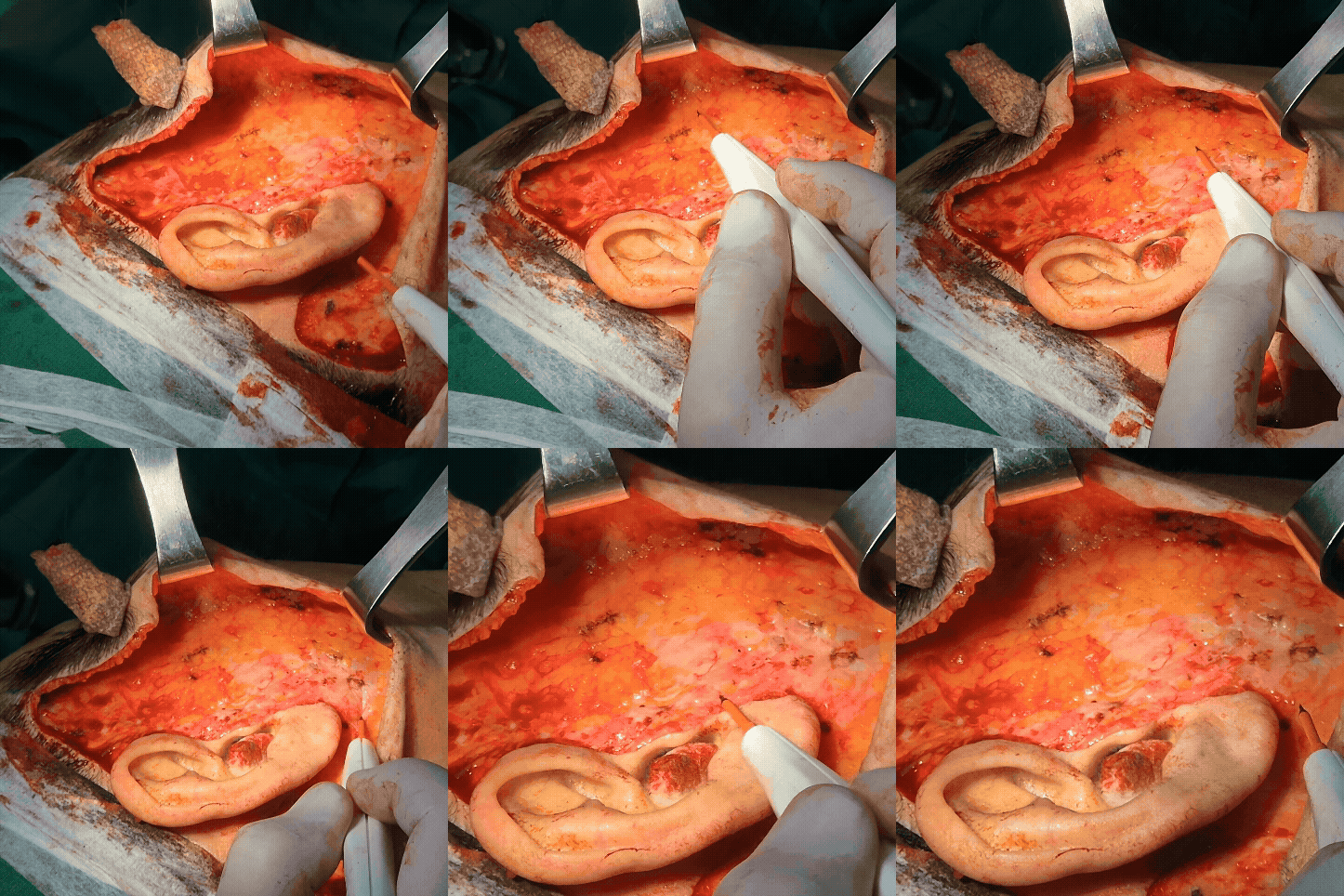
▲ A clear boundary between the area where the fascia had thinned and turned pale as a result of the initial surgery, and the yellow-toned area where the fascia remained intact and preserved
As shown in the image, the area where fascial manipulation had taken place was confined to roughly one finger's width in front of the ear, while the fascia anterior to that area remained completely intact.
In a standard facelift procedure, dissection should extend well beyond the preserved fascial area shown in this image, reaching much further forward.
3. Preventing Facelift Complications Requires Adequate Fascial Dissection
Preventing complications from facelift surgery is not simply a matter of controlling how much skin is removed.
The deeper fascial layer must also be sufficiently dissected, so that the lifting force is generated from this layer rather than placing unnecessary tension on the skin. Only then can Pixie Ear Deformity be prevented and scarring kept to a minimum.
Procedures with limited dissection, such as MINI Facelifts, may seem appealing in the short term due to faster recovery and a smaller-looking incision scar. However, without sufficient fascial manipulation to support the lift, complications such as Pixie Ear Deformity can occur, potentially requiring additional corrective surgery down the line.
A facelift performed with adequate fascial dissection distributes tension through the deeper tissue rather than the skin, which structurally reduces the likelihood of developing a Pixie Ear Deformity.
This is precisely why, when choosing a surgical approach, it is far more important to understand which tissue layer is being addressed and to what extent, rather than focusing solely on the name of the procedure or how quickly recovery is expected to be.
We hope today's discussion offers some helpful insight, whether you are hesitant about surgery due to concerns over facelift complications, or you are currently searching for a solution after already experiencing a Pixie Ear Deformity.
-
26.07.15